
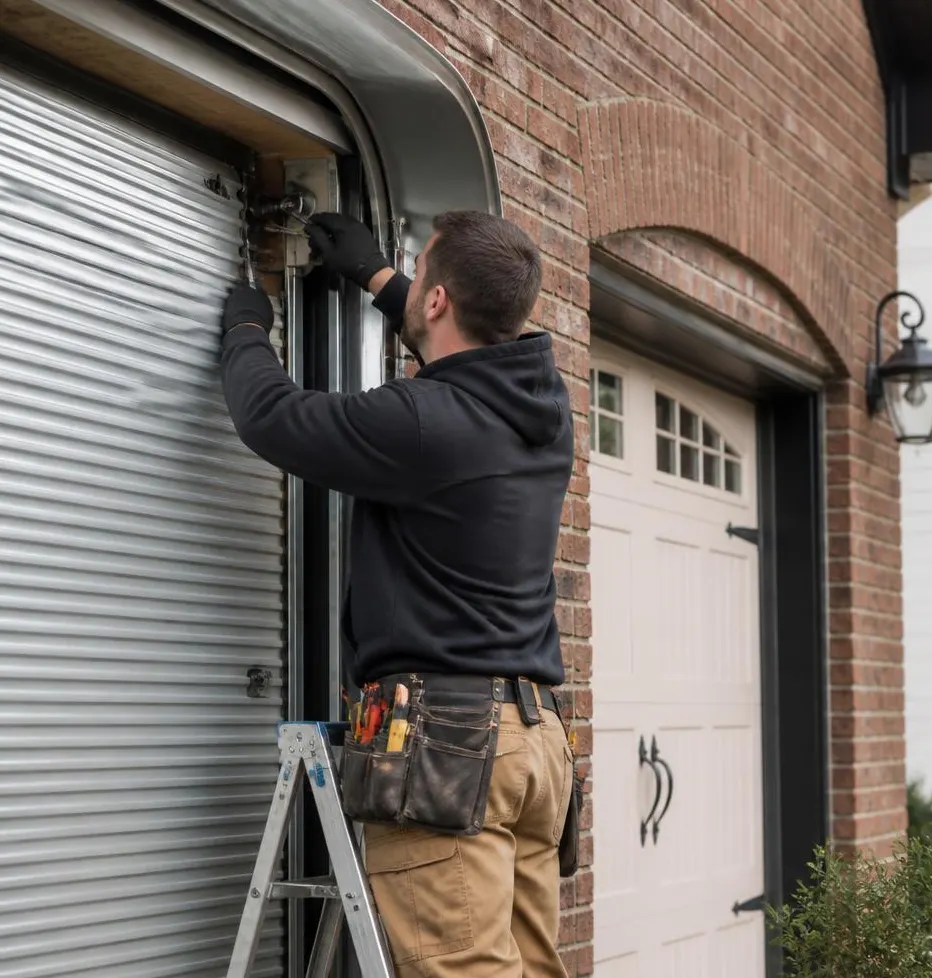
What a Technician Sees This Time of Year
Right about now, the calls start sounding the same. A homeowner's garage door worked fine all fall, and then one morning after the first real cold snap it groans going up, reverses halfway down, or just sits there while the opener motor hums uselessly. Nine times out of ten, it's not one big failure — it's a handful of small things that cold weather exposes all at once: stiff springs, dried-out rollers, a weatherstrip that's cracked and letting in drafts, or sensors knocked out of alignment by a bump from a car bumper or a snowblower. None of these are dramatic on their own, but combined with a deep freeze, they turn into a door that won't open the morning you need to leave for work.
Why Downriver Winters Are Hard on Garage Doors
This part of Michigan doesn't do mild winters. Deep cold, heavy snow, ice, and months of road salt tracked in on tires all take a toll on a system that's mostly metal, moving parts, and rubber seals. Cold makes steel springs more brittle and less willing to flex, which is exactly when extra strain from ice or a stuck track can cause a spring to snap. Salt and slush eat away at exposed hardware and can corrode tracks and rollers faster than most people expect. And the freeze-thaw cycle common in this area — cold snap, slight warm-up, cold again — is tough on weatherstripping and anything with a rubber seal.
A Practical Pre-Winter Checklist
1. Lubricate the Moving Parts
Rollers, hinges, and the torsion spring itself should get a garage-door-specific lubricant (not WD-40, which is a cleaner, not a lubricant) before the cold really sets in. Cold metal moving against cold metal with no lubrication is how you get grinding noises and premature wear.
2. Check the Weatherstripping and Bottom Seal
Walk around the door on a bright day and look for daylight coming through gaps, or run your hand along the bottom seal for cracks and flattened spots. A worn seal lets in cold air, snowmelt, and road salt spray, which speeds up rust on the bottom panel and hardware.
3. Test the Balance
Disconnect the opener, lift the door halfway by hand, and let go. It should stay roughly in place. If it drops or shoots up, the springs are out of balance — and an unbalanced door puts extra strain on the opener motor right when cold weather is already making the mechanism stiffer.
4. Inspect the Springs Closely
Look for gaps in the coils, rust, or visible stretching. Torsion springs have a lifespan measured in cycles, and winter is when a spring near the end of its life is most likely to fail, since cold metal has less give.
5. Clean the Tracks
Road salt and winter grime build up in the tracks over the season. Wipe them down and check for bends or debris that could cause the rollers to bind once ice starts forming.
6. Check the Opener and Safety Sensors
Cold weather is tougher on opener batteries (for battery-backup models) and can make belt or chain drives run stiffer. Make sure the safety sensors near the floor are aligned and the lenses are clean — road salt dust and winter grime on the sensor eyes is a common reason a door refuses to close for no obvious reason.
When to Call Southgate Garage Door
If the balance test fails, the springs look worn, or the door is struggling and you'd rather not find out the hard way on a sub-zero morning, that's the point to call in a technician rather than push through it. Southgate Garage Door handles garage door maintenance visits that cover lubrication, balance checks, and hardware inspection in one trip, and if a spring is showing its age, our spring replacement service gets it swapped out before it fails on its own terms — usually at the worst possible moment. We also handle opener issues, from misaligned sensors to units that are struggling in the cold.
If you're in Southgate, Wyandotte, Allen Park, Lincoln Park, Taylor, Riverview, Trenton, or Brownstown Township and want your garage door squared away before winter settles in for good, give Southgate Garage Door a call. We'll get it done right, the first time.